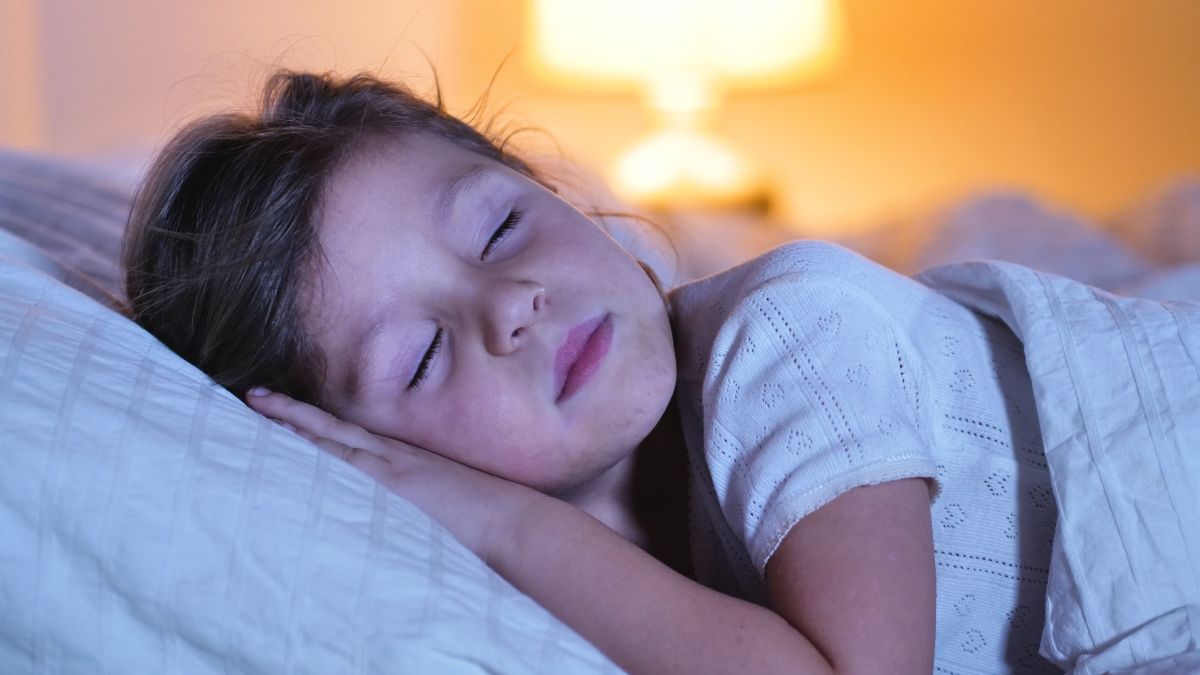
For many anxious children and adolescents, bedtime can be the most challenging part of the day. While daytime routines such as school, homework, and social interactions may appear manageable, nighttime often brings a noticeable increase in worry.
Children frequently report repetitive thoughts as they try to fall asleep. These thoughts often take the form of “What if” questions, such as concerns about safety, health, performance, or the unknown. Parents may observe that a child who seemed settled earlier in the evening suddenly seeks reassurance, asks repeated questions, or struggles to relax.
Knowing why this pattern occurs can help caregivers respond in ways that support long-term emotional regulation rather than short-term relief.
Pattern
Anxiety in children often becomes more pronounced at night due to a reduction in external distractions. During the day, attention is directed toward structured activities, conversations, and tasks. These elements help occupy cognitive resources.
At night, the environment changes:
| Daytime | Nighttime |
|---|---|
| School and tasks | Reduced stimulation |
| Social interaction | Increased quiet |
| Structured routine | Open mental space |
With fewer external inputs, internal thoughts become more noticeable. For children who are already prone to worry, this shift can lead to an increase in repetitive thinking.
The brain attempts to fill the quiet with predictions, often focusing on uncertainty or potential risks.
Mechanism
From a psychological perspective, these “What if” questions are linked to a need for certainty. Anxiety often drives individuals to seek clear answers to reduce discomfort.
However, many of the concerns children raise at night involve situations that cannot be definitively resolved in the moment. For example, questions about future events or unlikely scenarios do not have immediate answers.
This creates a cycle:
| Step | Process |
|---|---|
| 1 | Child experiences uncertainty |
| 2 | Brain generates “What if” question |
| 3 | Child seeks reassurance |
| 4 | Temporary relief is achieved |
| 5 | Uncertainty returns |
Because certainty is not fully attainable, the cycle repeats. Over time, the child may become more reliant on reassurance as a way to manage discomfort.
Reassurance
Parents often respond to nighttime worries with reassurance. Common responses include statements such as:
- “You will be fine”
- “Nothing bad is going to happen”
- “You always fall asleep”
- “Everything will be okay”
While these responses are well-intended, they may unintentionally reinforce the anxiety cycle. Reassurance can provide immediate comfort, but it does not address the underlying difficulty with uncertainty.
This pattern is sometimes referred to as a reassurance loop:
| Element | Effect |
|---|---|
| Reassurance given | Reduces anxiety briefly |
| Relief experienced | Reinforces behavior |
| Worry returns | Prompts more reassurance-seeking |
As a result, children may continue to ask similar questions, especially at bedtime.
Approach
An alternative approach focuses on helping children tolerate uncertainty rather than eliminating it. This involves responding in ways that acknowledge the child’s feelings while avoiding extended explanations or repeated reassurance.
Examples of supportive responses include:
- “That sounds like your worry brain talking”
- “You do not have to solve that right now”
- “We can handle that if it happens”
- “Let’s allow your mind to rest”
These responses serve several functions:
| Function | Description |
|---|---|
| Validation | Acknowledges the child’s experience |
| Containment | Limits engagement with the worry |
| Redirection | Encourages shifting attention |
This approach helps children learn that thoughts can exist without requiring immediate resolution.
Regulation
In addition to verbal responses, supporting the child’s physical state can be helpful. Anxiety is not only cognitive but also physiological.
Simple strategies may include:
| Strategy | Purpose |
|---|---|
| Slow breathing | Reduces physiological arousal |
| Consistent bedtime routine | Signals safety and predictability |
| Quiet environment | Minimizes additional stimulation |
When the body is more regulated, the intensity of anxious thoughts may decrease.
Development
It is important to recognize that traits often associated with anxiety, such as imagination, sensitivity, and conscientiousness, can also be strengths. These characteristics contribute to creativity, empathy, and awareness.
However, at night, these same traits may increase the likelihood of imagining worst-case scenarios.
Helping children manage these tendencies involves guiding them toward balanced thinking rather than attempting to suppress their thoughts entirely.
Outcome
Over time, consistent responses that emphasize tolerance of uncertainty can reduce reliance on reassurance. Children begin to know that they do not need complete certainty in order to feel safe enough to sleep.
This shift supports:
- Increased emotional resilience
- Reduced repetitive questioning
- Improved ability to self-soothe
Importantly, the goal is not to eliminate worry, but to change the child’s relationship with it.
Nighttime anxiety is a common experience, particularly for children who are prone to overthinking. By adjusting how caregivers respond to “What if” questions, it is possible to interrupt the reassurance cycle and support the development of more adaptive coping strategies.
When children learn that uncertainty can be tolerated, bedtime becomes less about solving every worry and more about allowing the mind and body to settle.
FAQs
Why do kids get anxious at night?
Fewer distractions make worries more noticeable.
What are “What if” thoughts?
Anxiety-driven questions about uncertain outcomes.
Does reassurance help anxious kids?
It helps briefly but can reinforce worry patterns.
How can parents respond better?
Acknowledge feelings without over-reassuring.
Can kids learn to manage nighttime anxiety?
Yes, by building tolerance for uncertainty.