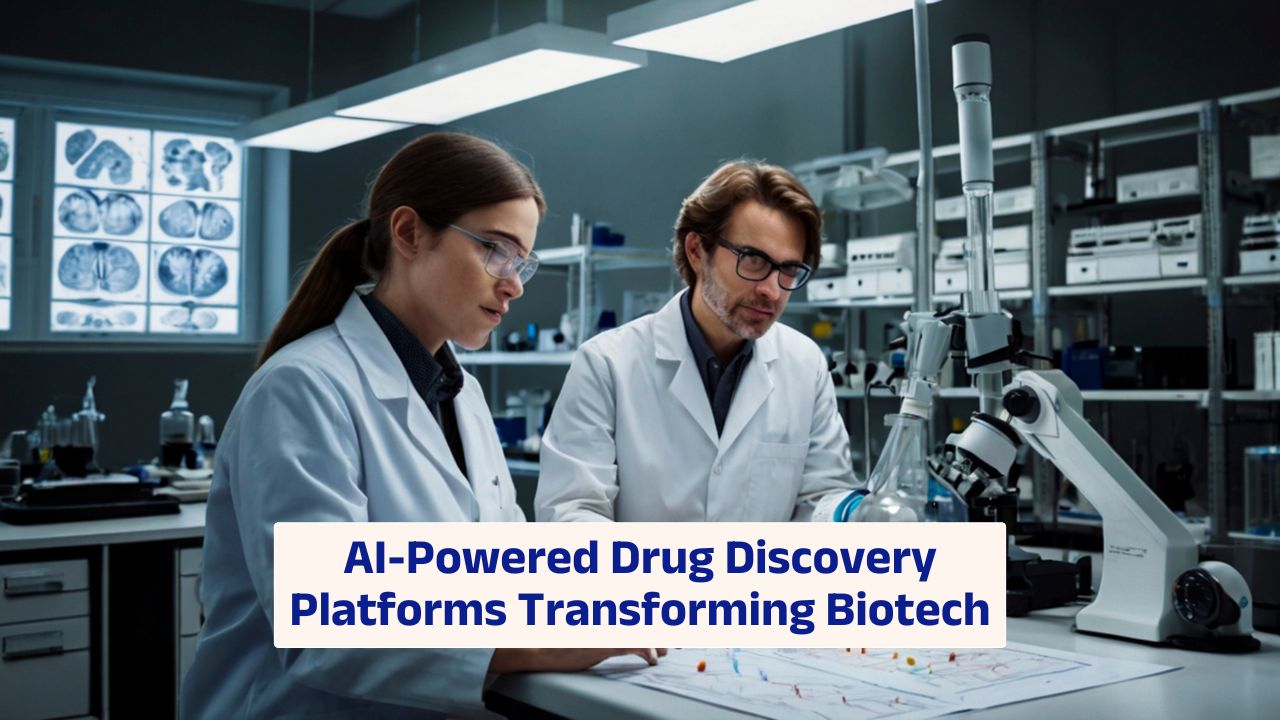
Artificial intelligence is rapidly redefining the architecture of drug discovery across the United States. AI-powered drug discovery platforms are no longer experimental add-ons to traditional research workflows but integrated engines shaping target identification, molecule design, and clinical candidate selection.
As capital efficiency pressures intensify and regulatory scrutiny remains high, biotech executives are increasingly evaluating how these platforms alter risk profiles and time-to-market assumptions.
Unlike earlier computational chemistry tools, modern AI platforms integrate multi-omics datasets, high-throughput screening outputs, and real-world clinical evidence into predictive models that continuously refine hypotheses.
The shift is not purely technological. It reflects structural change in how biotech companies allocate R and D capital, structure partnerships, and approach regulatory engagement with the FDA.
| Key Point | Details |
|---|---|
| Target Identification | Machine learning models analyze genomic and proteomic datasets to prioritize biologically relevant targets. |
| Molecule Design | Generative AI accelerates small molecule and biologic candidate design with improved hit rates. |
| Regulatory Alignment | Early engagement with the FDA ensures model validation and data integrity standards are met. |
| Capital Efficiency | Platform-based biotech models attract venture and public market interest due to scalable pipelines. |
| Partnership Strategy | Pharma collaborations increasingly center on AI platform access rather than single-asset licensing. |
Technology
AI-powered drug discovery platforms rely on deep learning architectures trained on vast chemical and biological datasets. These systems predict protein structures, ligand binding affinities, and toxicity signals before physical synthesis begins.
Integration of transcriptomics, CRISPR screening outputs, and imaging data allows platforms to model disease pathways at an unprecedented scale.
The regulatory environment has begun to adapt. The FDA guidance on artificial intelligence and machine learning outlines expectations around transparency, data governance, and algorithm validation. While primarily focused on medical devices, the framework signals how regulators expect AI systems in therapeutics development to demonstrate reproducibility and auditability.
Scientific credibility remains paramount. Publications in journals such as Nature Reviews Drug Discovery increasingly highlight validated AI-derived candidates entering clinical trials. Peer-reviewed validation is becoming a commercial differentiator, particularly for publicly traded biotech companies seeking credibility with institutional investors.
Regulation
In the United States, AI does not alter the fundamental Investigational New Drug pathway. Sponsors must still demonstrate safety, pharmacology, and manufacturing compliance under existing FDA frameworks. However, AI introduces new questions around data provenance, model bias, and explainability, particularly when algorithmic predictions influence preclinical decisions.
Biotech companies deploying AI platforms are increasingly engaging regulators earlier, often during pre-IND meetings. Transparent documentation of training datasets, model validation protocols, and version control processes helps mitigate regulatory risk. For platform companies, compliance infrastructure becomes as important as computational innovation.
Federal agencies, including NIH and HH, S are also funding AI research initiatives to standardize data interoperability and promote responsible AI integration. These programs influence how academic spinouts structure technology transfer agreements and protect intellectual property derived from federally funded datasets.
Commercialization
The commercialization model for AI-powered drug discovery platforms diverges from traditional single-asset biotech strategies.
Rather than advancing one molecule through development, platform companies position themselves as repeatable innovation engines. This approach supports multi-asset pipelines, milestone-driven partnerships, and diversified risk exposure.
Large pharmaceutical companies increasingly pursue structured collaborations that combine upfront payments, equity investments, and shared data access.
These partnerships allow pharma to externalize early discovery risk while maintaining downstream commercial rights. For AI biotech firms, such agreements validate platform scalability and strengthen valuations ahead of IPO or secondary offerings.
Public markets are responding selectively. Investors scrutinize whether AI claims translate into clinical progress rather than purely computational milestones. Demonstrated advancement into Phase I or Phase II trials remains the most persuasive signal that AI platforms generate clinically actionable candidates.
Outlook
AI-powered drug discovery platforms are unlikely to replace human scientific expertise. Instead, they are reshaping how expertise is deployed. Computational biologists, medicinal chemists, and regulatory strategists now operate within integrated digital ecosystems that accelerate hypothesis testing while preserving compliance discipline.
For US biotech executives, the strategic question is not whether to adopt AI but how to embed it responsibly within corporate governance and regulatory strategy.
Companies that align algorithmic innovation with FDA expectations, capital market transparency, and reproducible science will define the next generation of therapeutic development.
As reimbursement models and precision medicine frameworks evolve, AI-enabled discovery may also support more targeted patient stratification and biomarker-driven trials.
The competitive advantage will belong to organizations capable of integrating data science with disciplined clinical execution, translating computational insight into approved therapies.
FAQs
How do AI-powered drug discovery platforms reduce development risk?
AI platforms analyze large biological datasets to prioritize high-probability targets and filter out compounds with predicted toxicity early, potentially reducing costly late-stage failures.
Does the FDA have specific rules for AI in drug discovery?
The FDA applies existing drug development frameworks but expects transparency in data integrity, validation processes, and algorithm documentation when AI informs development decisions.
Are AI-discovered drugs reaching clinical trials?
Yes, several biotech companies have advanced AI-derived candidates into early-phase clinical trials, demonstrating that computational design can translate into investigational therapeutics.
How do investors evaluate AI biotech companies?
Investors look for evidence of platform scalability, validated partnerships with pharmaceutical companies, regulatory engagement, and progression of candidates into clinical stages.
Will AI replace traditional medicinal chemistry?
AI augments rather than replaces medicinal chemistry by accelerating hypothesis generation and compound optimization while human experts guide strategy and validation.