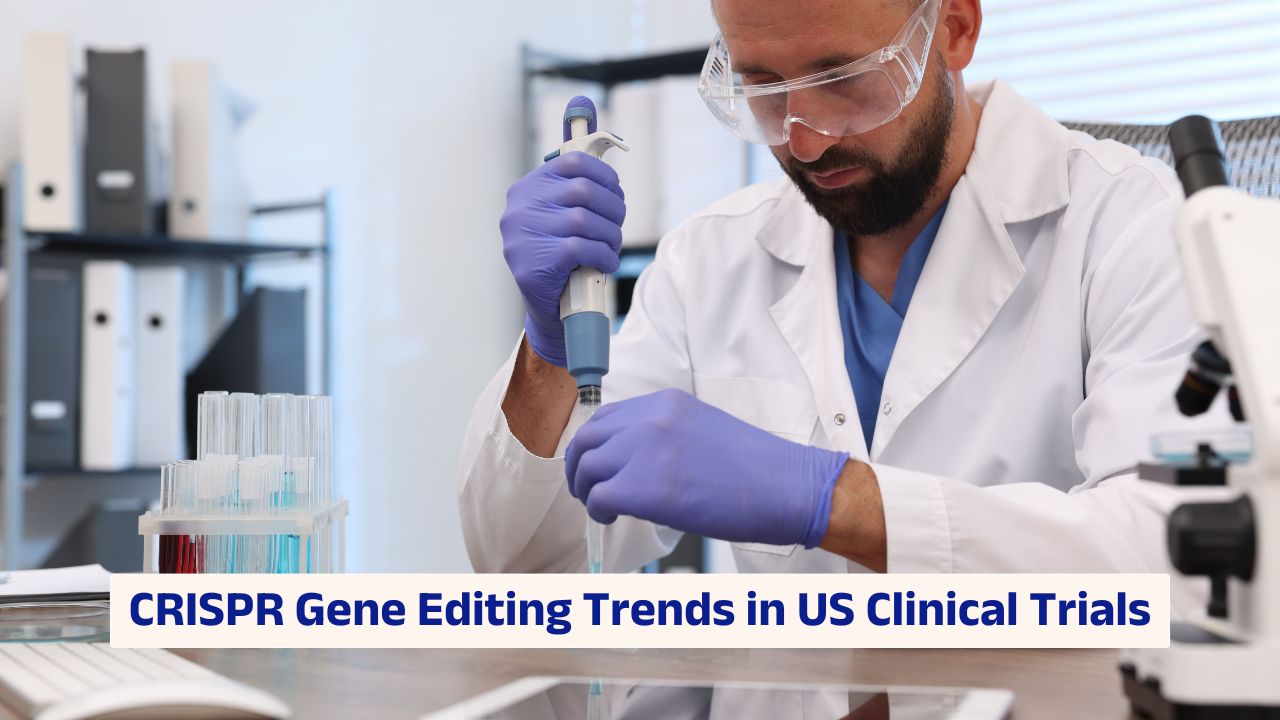
CRISPR gene editing trends in US clinical trials are entering a more disciplined phase defined by regulatory clarity, platform diversification, and maturing capital allocation. What began as proof-of-concept studies in rare hematologic disorders has expanded into oncology, in vivo editing, and next-generation delivery systems.
For biotechnology executives and investors, the trajectory of CRISPR programs now hinges as much on manufacturing scalability and safety monitoring as on editing efficiency.
| FDA emphasis on long-term safety follow-up and genomic off-target characterization | Details |
|---|---|
| Therapeutic focus | Expansion beyond rare blood disorders into oncology and in vivo liver and ophthalmology targets |
| Regulatory oversight | FDA emphasis on long term safety follow up and genomic off target characterization |
| Delivery innovation | Lipid nanoparticles and viral vectors compete as scalable in vivo delivery platforms |
| Manufacturing scale | Autologous ex vivo editing faces cost and turnaround time pressures |
| Capital markets | Selective investor appetite favors programs with differentiated safety and durability data |
Pipeline
Early US trials centered on ex vivo editing of hematopoietic stem cells for sickle cell disease and beta thalassemia. These programs validated that CRISPR-based approaches could achieve durable genetic modification with meaningful clinical endpoints.
As proof points accumulated, sponsors broadened pipelines into oncology, including engineered immune cell therapies and multiplex editing strategies designed to improve persistence and reduce immune evasion.
More recently, in vivo editing has gained traction. Programs targeting liver-expressed genes leverage lipid nanoparticle delivery systems to introduce CRISPR components directly into patients, reducing the need for individualized cell processing.
Ophthalmology has also emerged as a logical early in vivo indication given localized delivery and defined anatomical targets.
Regulation
CRISPR gene editing trends in US clinical trials are closely shaped by oversight from the U.S. Food and Drug Administration Office of Therapeutic Products. Sponsors must demonstrate not only therapeutic efficacy but also a comprehensive knowing of off-target edits, insertion and deletion profiles, and potential long-term oncogenic risk.
Chemistry, manufacturing, and controls documentation has become increasingly detailed as regulators expect reproducible editing performance across batches.
Long-term follow-up protocols are another defining feature. Gene-edited cell products may require extended monitoring to evaluate durability and late adverse events.
This expectation affects trial design, site selection, and patient retention strategies, particularly in rare disease populations where long-term data collection can be logistically complex.
Delivery
Delivery remains a central innovation frontier. Viral vectors, including adeno-associated virus platforms, provide established transduction efficiency but introduce payload constraints and immunogenicity considerations.
Non-viral approaches, such as lipid nanoparticles, offer repeat dosing potential and scalable manufacturing, though tissue targeting precision remains under optimization in some indications.
Emerging editing modalities, including base editing and prime editing, are entering early-stage US trials with the goal of increasing specificity and reducing double-strand breaks. For companies, differentiation increasingly depends on demonstrating superior safety margins rather than incremental editing rates alone.
Manufacturing
Ex vivo CRISPR programs face operational pressure tied to autologous cell processing. Turnaround time, vein-to-vein logistics, and cost of goods remain critical barriers to widespread commercialization.
Companies are investing in automation, closed system manufacturing, and regional production hubs to reduce variability and improve scalability.
In vivo platforms offer potential cost advantages, but they shift complexity into formulation science and quality control for nucleic acid components.
Sponsors must align manufacturing scale-up with evolving regulatory expectations, ensuring that clinical-grade materials meet stringent release specifications before pivotal expansion.
Capital
Investor sentiment toward CRISPR gene editing trends in US clinical trials has become more selective. Early enthusiasm based on platform promise has given way to scrutiny of clinical durability, safety transparency, and competitive positioning.
Public market performance on exchanges such as Nasdaq increasingly correlates with clearly defined regulatory milestones and differentiated datasets.
Strategic partnerships with established pharmaceutical companies have also become more common. These alliances distribute development risk, provide manufacturing infrastructure, and strengthen commercialization planning.
For emerging biotech firms, access to capital now depends on articulating a realistic pathway from phase one safety data to registrational endpoints aligned with FDA expectations.
As CRISPR gene editing matures within US clinical trials, the next inflection point will likely depend on demonstrating reproducible safety at scale and expanding into more prevalent indications.
Regulatory discipline, manufacturing reliability, and long-term follow-up infrastructure will determine whether gene editing transitions from high-potential innovation to a durable therapeutic class within the US healthcare market.
FAQs
What diseases are being targeted in US CRISPR clinical trials?
Early trials focused on sickle cell disease and beta thalassemia, with expansion into oncology, liver disorders, and ophthalmology indications.
How does the FDA regulate CRISPR gene editing therapies?
The FDA evaluates safety, off-target effects, manufacturing controls, and long-term follow-up plans before allowing progression through clinical phases.
What is the difference between ex vivo and in vivo CRISPR editing?
Ex vivo editing modifies cells outside the body before reinfusion, while in vivo editing delivers CRISPR components directly into the patient.
Why is delivery technology so important?
Effective and precise delivery determines editing efficiency, tissue targeting, safety profile, and commercial scalability.
What challenges remain for commercialization?
Manufacturing scale, cost control, long-term safety monitoring, and competitive differentiation remain central challenges for CRISPR developers.