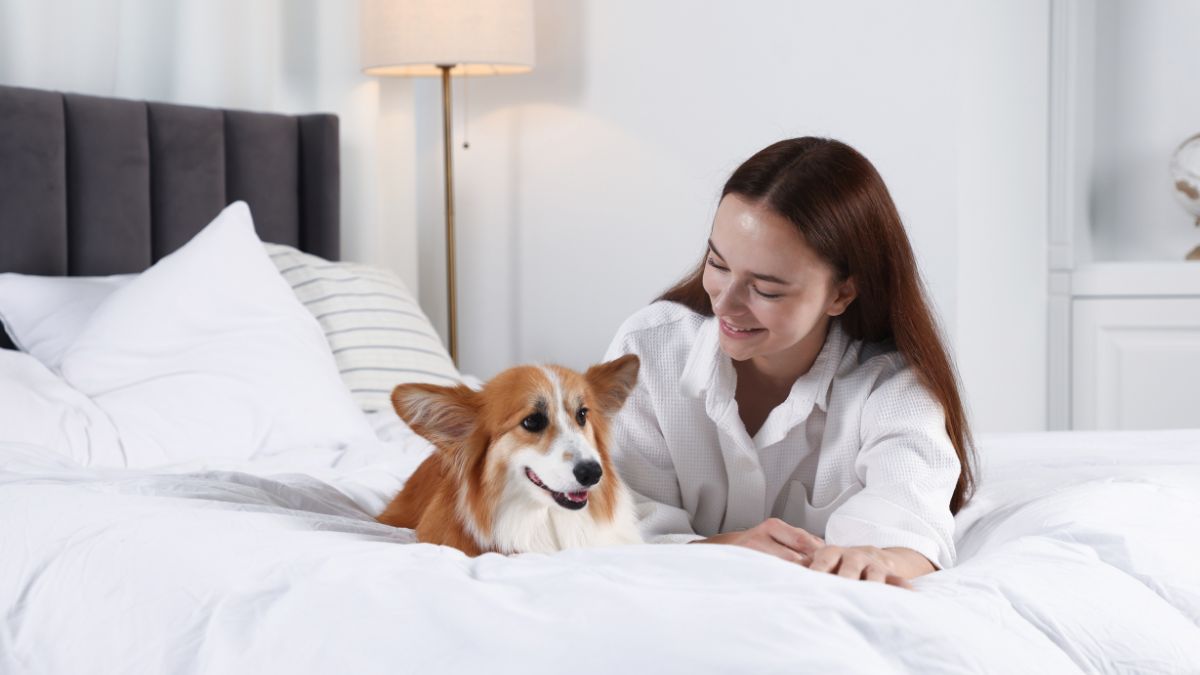
In recent years, a quiet shift has taken place in how people understand companionship. Behaviors once labeled as excessive or emotionally dependent, such as allowing pets to sleep in the bed, are now being reconsidered through a psychological lens. Rather than indicating weakness, these choices may reflect an adaptive response to the pressures of modern social life.
The idea that human relationships should be the sole source of emotional fulfillment is increasingly being questioned. At the same time, the role of animals in providing consistent, low-demand companionship is gaining recognition in both research and clinical settings.
Context
Sharing a sleeping space with a pet is often framed as a personal preference. However, it also reflects broader patterns in how individuals seek comfort and regulate stress.
Human relationships, while meaningful, often involve expectations. Communication requires attention, interpretation, and response. Social interactions may include subtle pressures related to behavior, appearance, or emotional availability.
In contrast, relationships with pets operate under a different structure. They are typically based on routine, proximity, and nonverbal interaction. This creates a form of connection that is less cognitively demanding.
Myth
A common assumption is that individuals who rely on pets for comfort are compensating for a lack of human connection. Psychological research does not consistently support this view.
Studies examining attachment styles suggest that many pet owners who form close bonds with animals also maintain healthy human relationships. The presence of a pet does not replace social interaction but adds another layer of support.
This distinction is important. It shifts the interpretation from substitution to supplementation.
Science
Empirical research provides insight into the physiological effects of human-animal interaction.
| Effect | Observed Outcome |
|---|---|
| Cortisol levels | Decrease with pet interaction |
| Oxytocin production | Increase during bonding |
| Heart rate | Often stabilizes |
| Sleep quality | Can improve for some individuals |
These findings indicate that interaction with pets can influence stress regulation. The presence of an animal, particularly in close physical proximity, may contribute to a sense of safety and calm.
Studies from institutions such as Washington State University and the Human-Animal Bond Research Institute have documented these effects across different populations, including individuals with elevated anxiety.
Presence
One of the defining characteristics of human-animal relationships is consistency. Pets do not require the same level of self-presentation that human interactions often involve.
In many social contexts, individuals monitor their behavior, tone, and responses. This process can be subtle but continuous. Over time, it may contribute to cognitive and emotional fatigue.
With pets, interaction is more direct. There is no expectation of performance in the conventional sense. This allows for periods of interaction that are less structured and less evaluative.
Pressure
Modern communication environments have increased the complexity of social interaction. Digital platforms, constant connectivity, and social comparison can heighten awareness of how one is perceived.
Research in social psychology has identified patterns such as “connection overload,” where individuals maintain frequent contact but still report feelings of isolation. The effort required to sustain multiple interactions can reduce the restorative value of those connections.
In this context, relationships that do not require continuous engagement or evaluation may serve a stabilizing role.
Sleep
The practice of allowing pets to sleep in the bed has been debated, particularly in relation to sleep quality. Earlier assumptions suggested that pets might disrupt rest. More recent findings present a more nuanced view.
For some individuals, the presence of a pet can enhance sleep by providing a sense of security and routine. The physical proximity of a familiar animal may reduce nighttime anxiety and support relaxation.
However, this effect is not uniform. Factors such as the pet’s behavior, size, and sleep patterns can influence outcomes. The benefits are most apparent when the animal’s presence is perceived as calming rather than disruptive.
Interpretation
The growing acceptance of close human-animal relationships reflects broader changes in how emotional well-being is understood.
Rather than viewing independence as the absence of reliance, current perspectives emphasize the value of multiple supportive connections. These connections can vary in form and function.
Pets provide a type of companionship that is stable, predictable, and less contingent on performance. This does not diminish the importance of human relationships, but it highlights the diversity of ways in which individuals meet emotional needs.
Balance
It is important to maintain a balanced perspective. While pets can offer meaningful support, they do not replace the complexity and depth of human interaction.
Healthy social functioning typically involves a range of relationships, each contributing in different ways. The role of pets can be understood as complementary rather than central.
Recognizing this balance helps avoid framing the behavior in overly positive or negative terms.
Perspective
The question of whether it is appropriate to let a pet sleep in one’s bed may be less significant than the reasons behind the choice.
For some, it is simply a matter of comfort or habit. For others, it reflects a broader pattern of seeking environments that reduce stress and provide consistency.
Knowing these motivations allows for a more informed view of the behavior, one that considers both psychological context and individual variation.
In summary, allowing a pet to sleep in the bed is not inherently indicative of emotional dependence. It can represent a practical and psychologically grounded way of accessing comfort in a complex social environment. As research continues to look into human-animal bonds, these everyday behaviors are increasingly seen as part of a broader framework of well-being rather than deviations from it.
FAQs
Is sleeping with pets psychologically healthy?
Yes, it can reduce stress and improve comfort.
Does it replace human relationships?
No, it usually complements them.
Can pets improve sleep quality?
Yes, for many people it provides calm.
Why do pets feel emotionally safe?
They offer consistent and nonjudgmental presence.
Is it a sign of dependency?
Not necessarily, it can be a healthy habit.