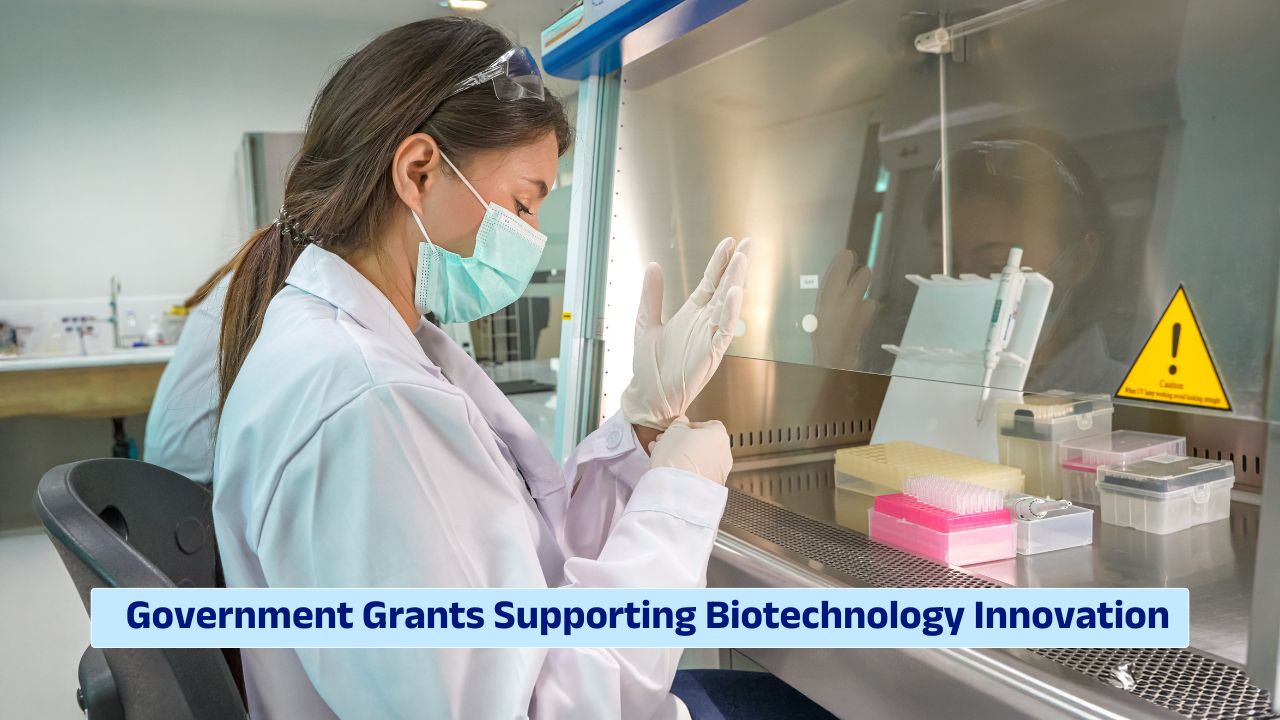
Government grants play a central role in advancing biotechnology innovation across the United States. Early-stage biotechnology research often requires substantial capital long before commercial products reach the market.
Public funding programs help bridge this gap by supporting foundational research, technology development, and early proof of concept studies that may otherwise struggle to attract private investment.
Federal agencies, research institutions, and innovation programs collectively fund a large portion of the biotechnology research ecosystem.
These grants support academic laboratories, emerging biotech startups, and collaborative research initiatives that contribute to breakthroughs in therapeutics, diagnostics, agricultural biotechnology, and industrial bioengineering.
| Government grants support early-stage biotechnology research and proof-of-concept development. | Details |
|---|---|
| Research Funding | Government grants support early stage biotechnology research and proof of concept development. |
| Startup Support | Innovation programs provide funding to emerging biotech companies developing new technologies. |
| Agency Leadership | Federal agencies such as NIH and NSF fund research in medicine, synthetic biology, and biotechnology platforms. |
| Commercial Pathways | Grant programs help startups advance toward clinical development and regulatory pathways. |
| Economic Impact | Public funding accelerates scientific observation and supports domestic biotechnology competitiveness. |
Funding
Government grant funding provides critical financial support during the earliest phases of biotechnology research. Many breakthrough technologies originate in academic research environments where investigators depend on competitive grants to conduct experiments and generate foundational scientific insights.
These investigations frequently form the basis for future biotech companies and therapeutic innovations.
In the United States, one of the largest sources of biomedical research funding is the National Institutes of Health research grants program. NIH funding supports research institutions, hospitals, and biotechnology investigators working across fields such as genomics, immunotherapy, gene editing, and drug research.
Programs
Several federal grant programs specifically target biotechnology startups and emerging technologies. Among the most influential initiatives are the Small Business Innovation Research and Small Business Technology Transfer programs.
These initiatives provide competitive funding to early-stage companies that are developing innovative scientific or technological solutions.
These programs allow startups to validate new biotechnology concepts without immediately relying on venture capital funding. Early phase grants typically support feasibility studies, prototype development, and preclinical research.
Successful projects may later progress to larger funding rounds or strategic partnerships with pharmaceutical companies.
The structure of these programs encourages collaboration between academic institutions and commercial biotechnology firms.
Details about these programs and eligibility requirements are available through the Small Business Innovation Research program portal, which coordinates federal innovation funding across multiple government agencies.
Commercialization
Government grants not only support scientific observation but also help biotechnology innovations move toward commercialization.
Funding can enable companies to generate the experimental data required for regulatory submissions, intellectual property protection, and investor engagement.
Many biotechnology startups rely on early grant funding to establish proof of concept for therapeutic platforms, diagnostic technologies, or bioengineering solutions.
This validation phase is essential before companies can attract venture capital investment or strategic partnerships with larger pharmaceutical organizations.
Ecosystem
Public investment in biotechnology research also strengthens the broader innovation ecosystem. Government grants help universities develop advanced research infrastructure and train the next generation of scientists and engineers.
These investments contribute to a skilled workforce capable of supporting future biotech growth.
Regional biotechnology clusters across the United States often emerge around institutions that receive substantial federal research funding.
These clusters encourage collaboration among universities, startups, pharmaceutical companies, and venture capital firms, creating environments where scientific observations can more easily translate into commercial biotechnology products.
As biotechnology continues to influence areas such as precision medicine, synthetic biology, and advanced therapeutics, government grant programs will remain an essential driver of innovation.
Sustained public investment helps ensure that early scientific breakthroughs can progress toward real-world healthcare and industrial applications, reinforcing the United States position as a global leader in biotechnology development.
FAQs
What are biotechnology government grants?
Biotechnology government grants are public funding programs that support research, development, and innovation in areas such as therapeutics, diagnostics, and synthetic biology.
Which US agencies fund biotechnology research
Major agencies include the National Institutes of Health, the National Science Foundation, and several federal innovation programs that support biotechnology development.
What is the purpose of the SBIR program?
The Small Business Innovation Research program provides funding to early-stage companies developing innovative technologies, including many biotechnology platforms.
How do biotech startups benefit from government grants
Grants allow startups to conduct early research, develop prototypes, and generate proof of concept data before seeking venture capital investment.
Why are government grants important for biotechnology innovation
Public funding helps support high-risk scientific research and early-stage research that can later lead to commercial biotechnology products and medical breakthroughs.