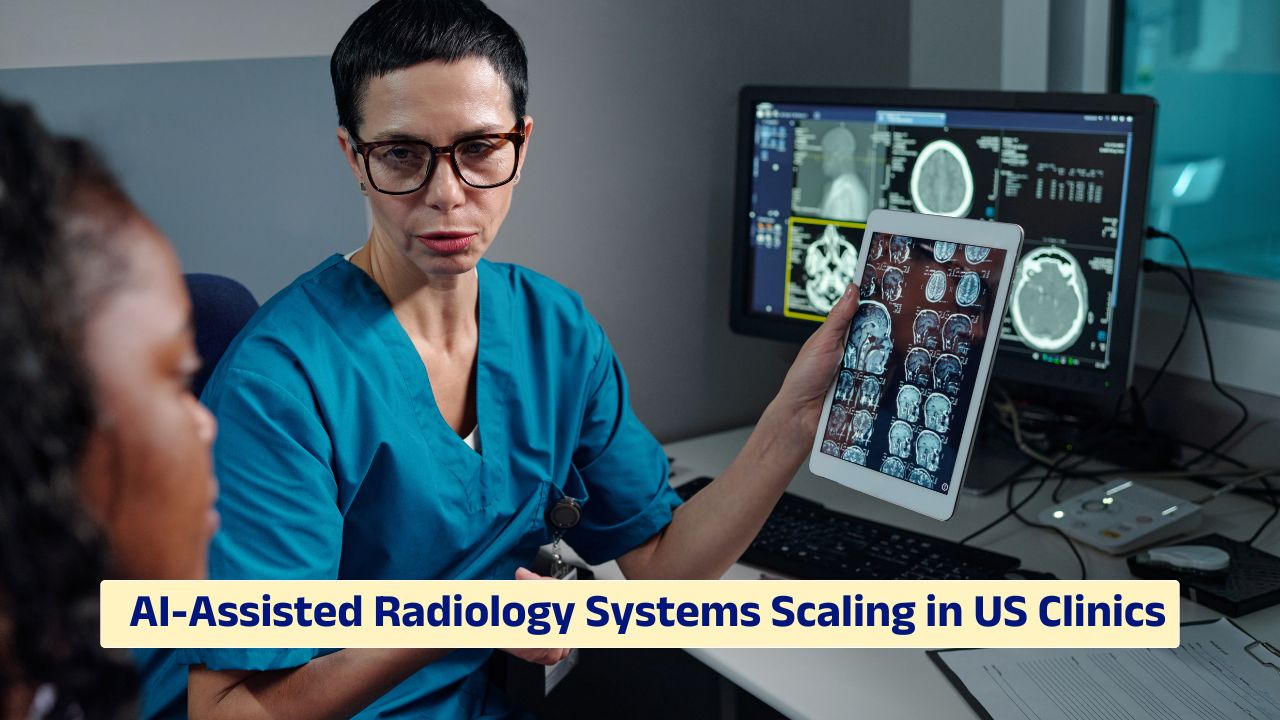
AI-assisted radiology systems are rapidly scaling across US clinics as healthcare providers seek to address diagnostic backlogs, workforce shortages, and rising imaging demand. The integration of artificial intelligence into radiology workflows is no longer experimental; it is becoming operational infrastructure.
Hospitals and outpatient imaging centers are adopting these tools to enhance accuracy, reduce turnaround times, and improve clinical decision support.
| Key Point | Details |
|---|---|
| Clinical Efficiency | AI tools automate image triage and reduce radiologist workload |
| FDA Oversight | Regulatory pathways for AI-based imaging software are evolving |
| Reimbursement Trends | CMS policies influence adoption and provider incentives |
| Interoperability | Integration with PACS and EHR systems remains critical |
| Market Expansion | Growing investment in AI imaging startups and platforms |
Adoption
The scaling of AI-assisted radiology systems is closely tied to operational pressures within US healthcare systems. Radiology departments are experiencing increasing imaging volumes, particularly in CT and MRI modalities, without proportional growth in the radiologist workforce.
AI-driven triage tools are helping prioritize urgent cases, enabling faster intervention for conditions such as stroke, pulmonary embolism, and intracranial hemorrhage.
Large health systems are leading adoption, often deploying AI solutions across multiple sites to standardize workflows.
Community clinics and outpatient centers are following, driven by the need to remain competitive and improve patient throughput. This diffusion reflects a shift from pilot programs to enterprise-wide implementation strategies.
Technology
AI-assisted radiology platforms rely on deep learning algorithms trained on large imaging datasets. These systems are capable of detecting abnormalities, quantifying disease progression, and flagging critical findings.
Integration with picture archiving and communication systems ensures that AI outputs are embedded directly into radiologist workflows, minimizing disruption.
Cloud-based deployment models are also gaining traction, enabling scalable processing and continuous model updates. This approach supports multi-site healthcare networks and facilitates real-time data sharing.
However, it also introduces considerations around data security and compliance with federal privacy regulations.
Regulation
The US Food and Drug Administration plays a central role in regulating AI-assisted radiology systems. Many of these tools are classified as software as a medical device, requiring premarket clearance or approval depending on risk classification.
The FDA has also introduced frameworks for adaptive algorithms, recognizing that AI models may evolve over time.
Guidance on AI and machine learning in medical devices can be reviewed through the FDA software as a medical device resource. These frameworks emphasize transparency, validation, and post-market monitoring, which are critical for maintaining clinical trust.
In parallel, the National Institutes of Health continues to support research into AI validation and bias mitigation. Ensuring that algorithms perform consistently across diverse patient populations remains a key regulatory and ethical priority.
Reimbursement
Reimbursement policies are a significant determinant of adoption. The Centers for Medicare and Medicaid Services has begun to recognize certain AI-enabled diagnostic tools under specific billing codes, signaling a shift toward broader acceptance.
However, reimbursement remains inconsistent, and many AI applications are still bundled within existing imaging payments.
Providers are evaluating return on investment based on efficiency gains rather than direct reimbursement. Reduced report turnaround times, improved diagnostic accuracy, and lower error rates contribute to operational value.
Over time, more explicit reimbursement pathways may emerge as evidence of clinical utility strengthens.
Markets
The market for AI-assisted radiology systems is expanding rapidly, with significant venture capital activity and strategic acquisitions. Biotech and health technology companies are competing to develop specialized algorithms targeting high-value use cases, including oncology imaging and cardiovascular diagnostics.
Publicly traded companies on Nasdaq are increasingly incorporating AI imaging capabilities into their portfolios, reflecting investor interest in scalable digital health solutions.
Partnerships between AI developers and imaging equipment manufacturers are also accelerating commercialization, enabling bundled offerings that integrate hardware and software.
Barriers
Despite strong momentum, several barriers remain. Integration challenges with legacy systems can delay implementation, particularly in smaller clinics with limited IT infrastructure. Interoperability standards are still evolving, and seamless data exchange across platforms is not always guaranteed.
Algorithm transparency and clinical validation are also ongoing concerns. Radiologists must know how AI outputs are generated to confidently incorporate them into decision-making. Regulatory expectations around explainability are likely to intensify as adoption increases.
Liability considerations further complicate deployment. Determining responsibility in cases where AI-assisted interpretations contribute to diagnostic errors remains an unresolved issue, with implications for providers, developers, and insurers.
AI-assisted radiology systems are transitioning from innovation to infrastructure within US healthcare. As regulatory clarity improves and reimbursement pathways evolve, these technologies are expected to become integral to diagnostic workflows.
For healthcare executives and biotech leaders, the focus will increasingly shift toward scalable deployment, clinical validation, and alignment with federal policy frameworks.
FAQs
What are AI-assisted radiology systems?
AI-assisted radiology systems use machine learning algorithms to analyze medical images, detect abnormalities, and support radiologists in diagnosis.
Why are US clinics adopting AI in radiology?
US clinics are adopting AI to manage increasing imaging volumes, reduce diagnostic delays, and improve accuracy in clinical decision-making.
How does the FDA regulate AI radiology tools?
The FDA regulates AI radiology tools as software as a medical device, requiring validation, approval, and ongoing monitoring for safety and effectiveness.
Are AI radiology systems reimbursed by CMS?
Some AI radiology tools are recognized under CMS reimbursement policies, but many are still included within existing imaging payment structures.
What challenges affect AI radiology adoption
Key challenges include system integration, data privacy, algorithm transparency, regulatory compliance, and unclear liability frameworks.