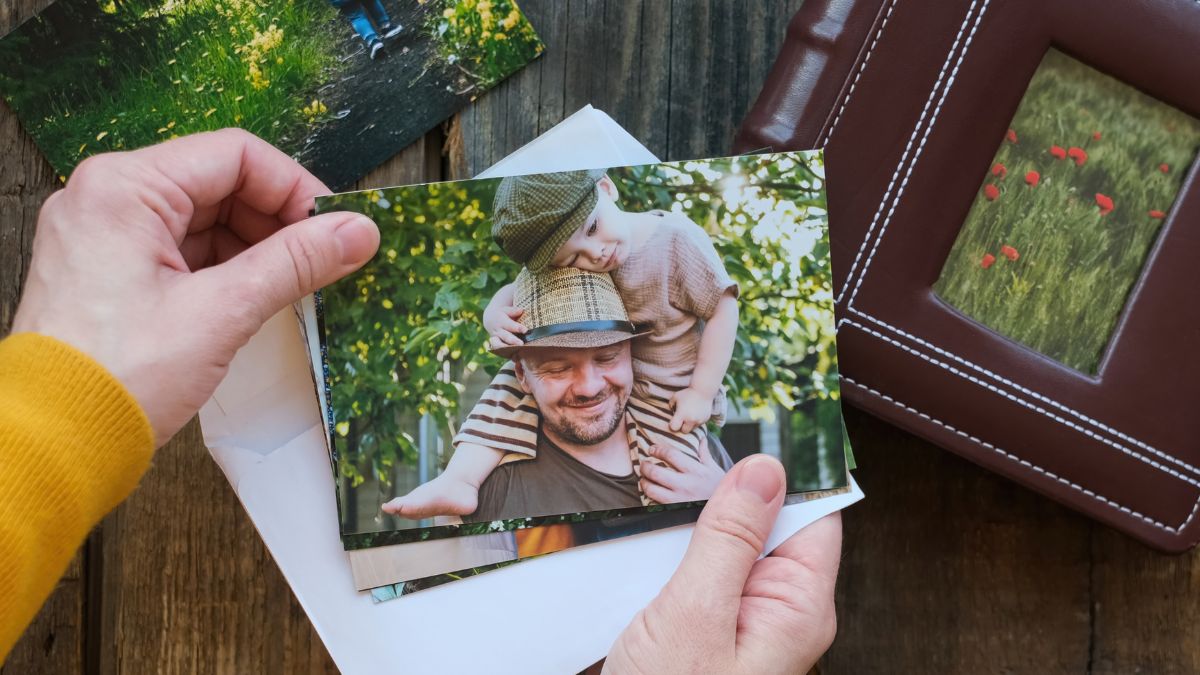
In a world saturated with selfies, screenshots, and endless scrolling, there is something quietly powerful about opening a drawer and finding printed photographs. Old albums that smell faintly of paper and time. Envelopes thick with moments someone once decided were worth keeping.
It feels old-fashioned, maybe even sentimental. But psychology suggests this habit isn’t just nostalgia clinging to relevance. It survives because it works with the way human memory actually functions.
Keeping printed photos close isn’t about rejecting technology. It’s about how the brain remembers, and what helps it remember best.
Anchors
Psychologists who study autobiographical memory, the system that stores the story of our lives, consistently find that physical objects create stronger memory anchors than digital ones.
Printed photographs act as tactile cues. When you touch one, your brain isn’t just seeing an image. It’s processing texture, weight, smell, and age. Those extra sensory details give memory more places to attach itself.
Open a drawer and suddenly you’re ten years old at a school sports day. You remember the heat, the noise, the feeling of standing next to someone who mattered. The photo doesn’t just remind you. It transports you.
Triggers
Memory relies on triggers. Smells, sounds, images, and objects act like keys that unlock stored experiences. Visual cues are especially powerful. Research shows that images help the brain retrieve details more effectively than words alone.
Printed photos do more than show a moment. The faded edges, the gloss worn dull, the handwritten date on the back all become part of the memory network. Even the smell of old paper can pull emotions forward before logic catches up.
This layered sensory experience is something phone screens struggle to replicate.
Selection
One reason printed photos feel heavier with meaning is because they are chosen.
Digital galleries are crowded with duplicates, screenshots, and images taken without intention. Printed photos require a decision. You don’t print everything. You print what mattered.
Psychologists note that selection itself strengthens memory. Choosing a photo reinforces its importance. It becomes evidence of a meaningful moment, not just another file stored away.
Printed photos, in that sense, are curated memories.
Identity
Memory isn’t just recall. It’s identity.
Psychologists often describe memory as the core thread of who we are. Printed photos, especially those kept over years or decades, become physical proof of a life lived. They anchor personal identity across time.
Seeing yourself as a child in a faded photograph doesn’t just remind you of what happened. It reminds you who you were, and how you became who you are now.
Studies show that photographs can trigger emotional memory more intensely than many other prompts. You don’t just remember the event. You feel it again.
Permanence
There is also comfort in physical permanence.
Digital images feel fragile. A hard-drive crash, a hacked account, or a forgotten password can erase years in seconds. Printed photos fade, but they don’t vanish quietly.
Sometimes you find them by accident. A drawer opened for something else. An envelope slipped between books. Suddenly, a forgotten summer reappears.
Psychologists call these moments involuntary autobiographical recall. A memory surfaces without effort, triggered by a sensory cue. Marcel Proust wrote about it. Scientists study it. People experience it constantly through music, letters, and photographs.
Printed photos excel at this kind of memory surprise.
Slowness
Modern tools make memory abundant but fast. Photos are taken, shared, and forgotten within minutes.
Printed photos slow the process down. They force a pause. Is this moment worth paper and ink? Is it worth space in a drawer?
That slowness adds weight. It turns memory from consumption into reflection.
Even modern lifelogging tools, wearable cameras that automatically photograph daily life, rely on this same principle. Studies show that people remember experiences more richly when they revisit them visually later.
But printed photos do something else. They make you linger.
Meaning
Psychologists are careful to say that printed photos are not objectively better than digital ones. Digital images allow connection, sharing, and documentation at a scale never before possible.
But printed photos encourage intention. Each one represents a choice, a pause, a moment elevated above the rest.
Keeping printed pictures isn’t about resisting progress. It’s about preserving meaning.
The next time you find an old photograph tucked into a drawer, notice what happens. Your brain may bring back more than an image. It may bring back a version of yourself you didn’t realize was still there.
FAQs
Do printed photos improve memory recall?
Yes, physical cues strengthen autobiographical memory.
Why do old photos feel more emotional?
They trigger sensory and emotional memory pathways.
Are printed photos better than digital ones?
Not better, but more intentional and tactile.
What is involuntary autobiographical recall?
Sudden memories triggered by sensory cues.
Why do people still print photos today?
To preserve meaningful moments more deeply.