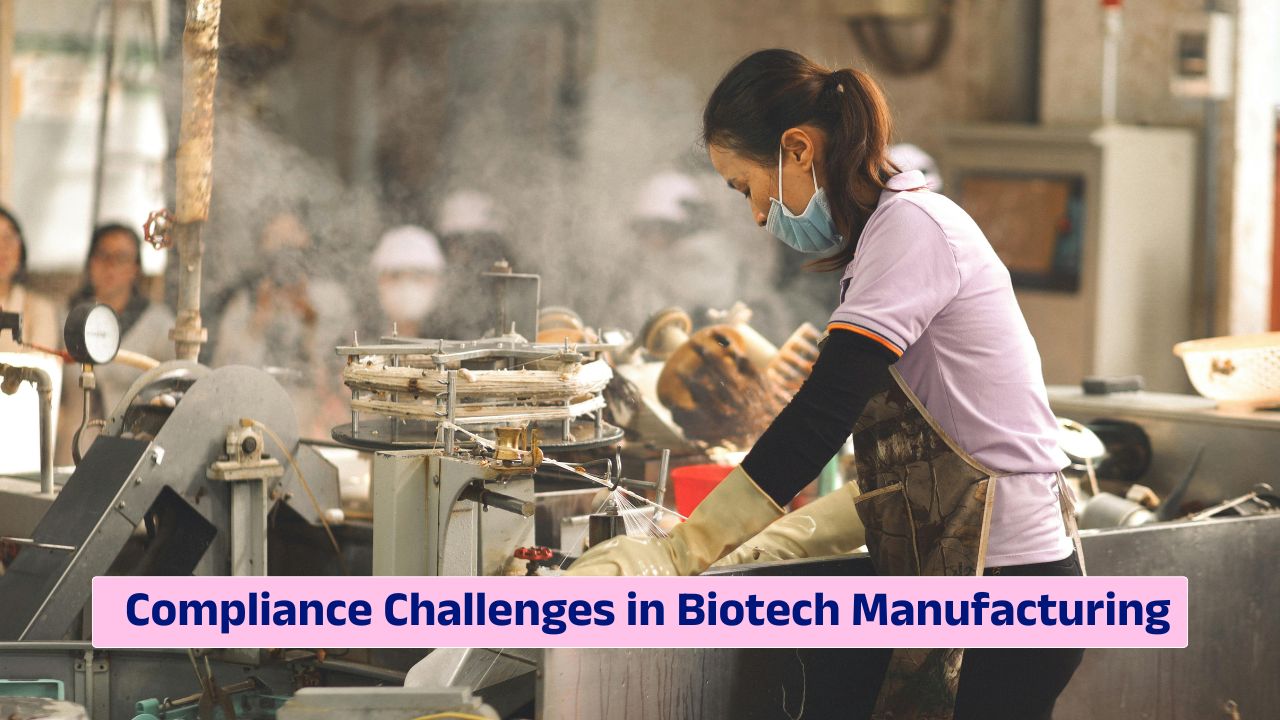
Compliance challenges in biotech manufacturing are intensifying as U.S. regulators apply heightened scrutiny to complex biologics, cell therapies, and gene-edited products.
As pipelines diversify and production technologies evolve, manufacturers must align advanced scientific processes with stringent regulatory expectations under current good manufacturing practice standards.
Unlike traditional small molecule facilities, biotech manufacturing environments often involve living cells, viral vectors, and sensitive biologic intermediates.
This complexity increases variability risk, documentation burden, and quality control requirements, placing regulatory strategy at the center of operational execution.
| Demonstrating reproducibility for cell-based and gene therapy products. | Primary Challenge |
|---|---|
| cGMP Standards | Maintaining validated processes for complex biologic production systems. |
| Data Integrity | Ensuring electronic batch records and audit trails meet FDA inspection standards. |
| Supply Chain Control | Managing raw material variability and global supplier qualification. |
| Process Validation | Demonstrating reproducibility for cell based and gene therapy products. |
| Inspection Readiness | Preparing for routine and for cause inspections by federal regulators. |
Regulatory
The U.S. Food and Drug Administration enforces biologics manufacturing standards through detailed inspection programs and guidance documents. Manufacturers must comply with regulations outlined in Title 21 of the Code of Federal Regulations, which governs cGMP requirements for biologics and drug products.
For advanced therapies, regulatory expectations often extend beyond baseline cGMP compliance. Sponsors must demonstrate control over vector production, cell expansion, and cryopreservation processes. Any deviation can trigger Form 483 observations or warning letters, potentially delaying product approvals.
Validation
Process validation remains one of the most persistent compliance challenges in biotech manufacturing. Unlike chemical synthesis, biological systems are inherently variable. Establishing validated ranges for critical process parameters requires extensive characterization studies and statistical analysis.
Continuous manufacturing and automation technologies add another layer of regulatory complexity. While they promise improved efficiency, companies must demonstrate that automated systems maintain consistent product quality and data traceability under FDA scrutiny.
Data
Data integrity has become a focal point of federal inspections. Electronic batch records, laboratory information management systems, and manufacturing execution systems must provide secure audit trails and controlled user access. Regulators increasingly assess cybersecurity safeguards alongside traditional quality metrics.
Failure to maintain accurate and contemporaneous documentation can undermine an otherwise robust manufacturing process. In high-value biologics production, documentation gaps may carry significant commercial consequences, including delayed launch timelines and investor concerns.
Supply
Global supply chains introduce additional compliance risks. Biotech manufacturers rely on specialized raw materials, including plasmids, growth media, and viral vector components sourced from qualified vendors. Supplier audits and quality agreements are critical to mitigating contamination and variability risks.
The FDA expects companies to maintain comprehensive oversight of contract manufacturing organizations. Clear delineation of responsibilities, change control procedures, and deviation management frameworks is essential to sustain regulatory confidence.
As biologics and advanced therapies expand across oncology, rare disease, and immunology markets, compliance challenges in biotech manufacturing will remain a strategic priority.
Companies that integrate quality by design principles, invest in digital compliance infrastructure, and engage proactively with regulators are better positioned to navigate inspections and scale commercial production.
In a competitive capital environment, manufacturing discipline increasingly serves as a differentiator that influences both regulatory outcomes and long-term valuation.
FAQs
What are the main compliance challenges in biotech manufacturing?
Key challenges include maintaining cGMP standards, ensuring data integrity, validating complex biologic processes, and managing global supply chains.
How does the FDA oversee biotech manufacturing?
The FDA conducts inspections, reviews documentation, and enforces compliance under Title 21 of the Code of Federal Regulations, focusing on quality systems and process control.
Why is process validation difficult for biologics?
Biologic production involves living systems that can vary, making it more complex to establish consistent and reproducible manufacturing parameters.
What role does data integrity play in compliance?
Accurate, secure, and traceable electronic records are essential to demonstrate regulatory compliance and withstand inspection scrutiny.
How can biotech firms reduce compliance risk?
Implementing quality by design, investing in digital systems, and maintaining proactive communication with regulators can reduce compliance risk.