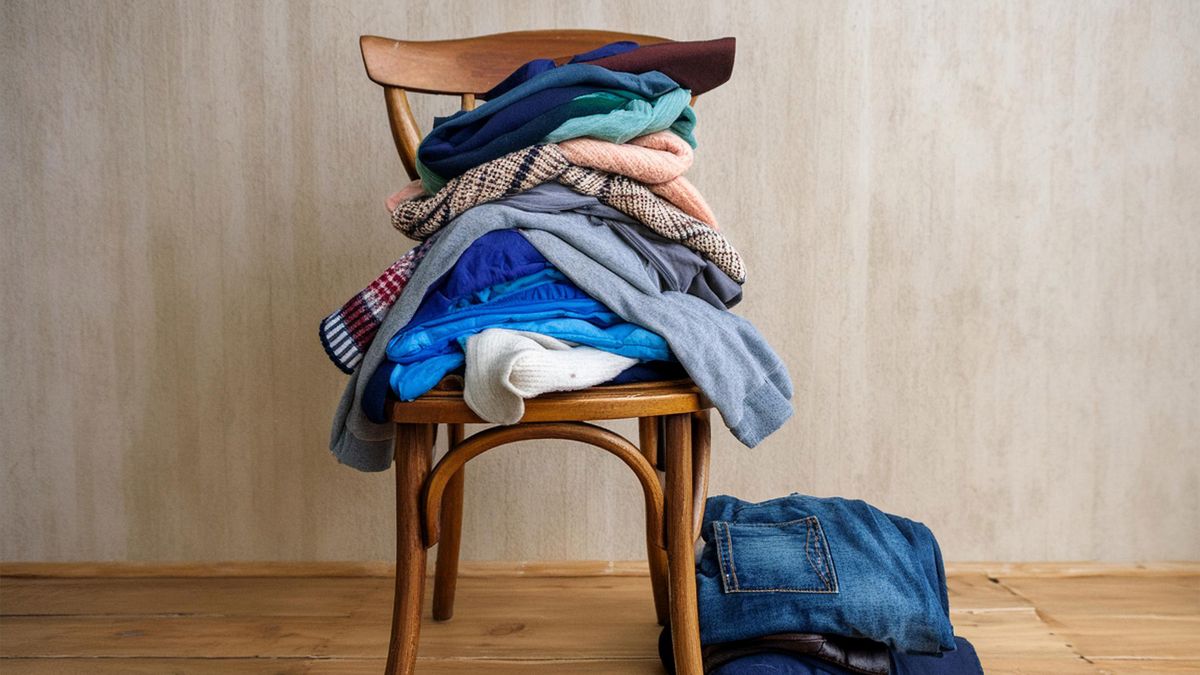
Many people have a chair in the bedroom that slowly turns into a temporary storage space for clothes. A shirt worn once, a jacket that may be reused, or jeans left out for the next day gradually form a growing pile. Although the habit appears harmless, psychologists say it may reflect broader behavioural patterns related to decision-making, mental fatigue, procrastination, and stress.
In recent years, behavioural psychology research has increasingly explored how everyday habits inside the home can mirror emotional and cognitive states. The so-called “clothes chair” has become a widely recognised example of this phenomenon.
Research on clutter and mental well-being suggests that disorganised environments may influence stress levels, mood, and concentration. A 2010 study by Darby E. Saxbe and Rena Repetti found that homes perceived as cluttered were associated with higher emotional distress and altered cortisol patterns, a hormone linked to stress. More recent mental health discussions have also connected clutter with cognitive overload and reduced focus.
Psychologists note that the issue is often less about laziness and more about how the brain handles repeated small decisions during periods of fatigue or overload.
Procrastination
One of the clearest explanations for the clothes chair habit comes from the psychology of procrastination.
Every piece of clothing creates a small decision:
- Put it back in the closet
- Place it in the laundry basket
- Wear it again later
Although these choices appear simple, the brain may classify them as non-urgent. As a result, the action gets delayed repeatedly.
Behavioural experts describe this as low-intensity procrastination, where minor tasks are postponed because they seem insignificant in the moment.
Over time, the brain becomes comfortable with the pattern of delaying resolution. The chair gradually turns into an “in-between space” where decisions remain unfinished.
| Clothing Decision | Common Response |
|---|---|
| Slightly worn shirt | Leave on chair |
| Jacket used briefly | Save for later |
| Uncertain laundry status | Delay decision |
The habit often develops slowly rather than intentionally.
Fatigue
Mental fatigue also plays a major role.
Throughout the day, people make continuous decisions involving work, communication, schedules, responsibilities, and social interactions. By evening, the brain naturally begins conserving energy.
Psychologists explain that when mental resources are low, even simple tasks may feel unnecessarily demanding.
Putting away clothes involves both physical effort and mental processing. A tired mind may avoid the task entirely, even when it would only take a few seconds.
This helps explain why many people follow the same pattern:
- Returning home exhausted
- Changing clothes quickly
- Leaving items on the chair temporarily
- Forgetting to organise them later
The behaviour is often linked more closely to exhaustion than to disorganisation itself.
Overload
Psychology research also suggests that physical surroundings can reflect emotional conditions.
Periods of stress, anxiety, burnout, or emotional overload frequently affect household organisation. During demanding periods, the brain prioritises urgent responsibilities while postponing lower-priority tasks.
The clothes chair can become a visible sign of this mental overload.
Researchers studying environmental psychology note that clutter sometimes functions as an external reflection of internal stress. This does not mean every messy room signals emotional problems, but repeated patterns may indicate that mental resources are stretched.
| Emotional State | Possible Household Effect |
|---|---|
| Stress | Increased clutter |
| Mental overload | Delayed small tasks |
| Anxiety | Reduced focus on organisation |
| Burnout | Difficulty completing routines |
The connection between environment and emotional state is often gradual rather than dramatic.
Decisions
Another key concept linked to this habit is decision fatigue.
Decision fatigue refers to the decline in mental energy that occurs after making repeated choices throughout the day. As decision-making capacity weakens, the brain begins avoiding additional choices whenever possible.
By the evening, deciding what to do with a piece of clothing may feel mentally unnecessary.
Psychologists emphasise that this avoidance is not simply laziness. Instead, it reflects a cognitive energy-saving mechanism.
The brain often chooses the easiest immediate option:
- Leave the item visible
- Delay the decision
- Return to it later
The problem is that “later” frequently never arrives, allowing accumulation to continue.
Systems
Not all clothes-chair behaviour is viewed negatively by psychologists.
In some cases, the chair functions as a practical temporary system. People may intentionally separate clothes that are not fully clean but not ready for washing either.
This creates convenience and saves time during busy routines.
However, the habit becomes problematic when the temporary system loses boundaries and turns into ongoing clutter.
Some individuals also have a higher tolerance for what psychologists call visual noise. They may remain comfortable in slightly disorganised spaces without experiencing stress.
Others are more sensitive to visible clutter and feel distracted or emotionally uncomfortable when objects remain out of place.
This means the same chair full of clothes can affect different people in very different ways.
Completion
One of the more important psychological interpretations involves task completion.
The clothes left on the chair represent unresolved actions. The task has technically started but has not fully ended.
Researchers note that unfinished tasks often remain active in the mind longer than completed ones, a phenomenon linked to the Zeigarnik Effect, where incomplete tasks continue occupying mental attention.
This pattern can sometimes appear in other areas of life:
- Unfinished projects
- Delayed emails
- Postponed decisions
- Incomplete household tasks
The chair may become a small physical reminder of unresolved responsibilities.
Balance
Psychologists also stress the importance of perspective. Accumulating clothes on a chair is extremely common and usually does not indicate a serious psychological condition.
The behaviour is very different from compulsive hoarding disorder, which involves severe difficulty discarding possessions and significant disruption to daily life.
In most cases, the clothes chair reflects ordinary human tendencies linked to fatigue, stress, delayed decisions, and modern routines.
Still, repeated small habits can offer insight into how people manage mental energy and daily responsibilities. Behavioural psychologists often emphasise that seemingly minor routines may reveal broader patterns in attention, organisation, and emotional balance.
The clothes chair may appear insignificant, but it highlights how the brain constantly negotiates between effort, decision-making, and energy conservation. For many people, the habit is less about disorder and more about how the mind responds to pressure, fatigue, and unfinished tasks in everyday life.
FAQs
Why do people pile clothes on chairs?
Often due to delayed small decisions and fatigue.
Is the clothes chair linked to stress?
Research suggests clutter may reflect mental overload.
What is decision fatigue?
It is reduced mental energy after many daily choices.
Does clutter always mean a mental problem?
No, everyday clutter is usually common and temporary.
Can unfinished tasks affect the mind?
Yes, unresolved tasks may stay active mentally.